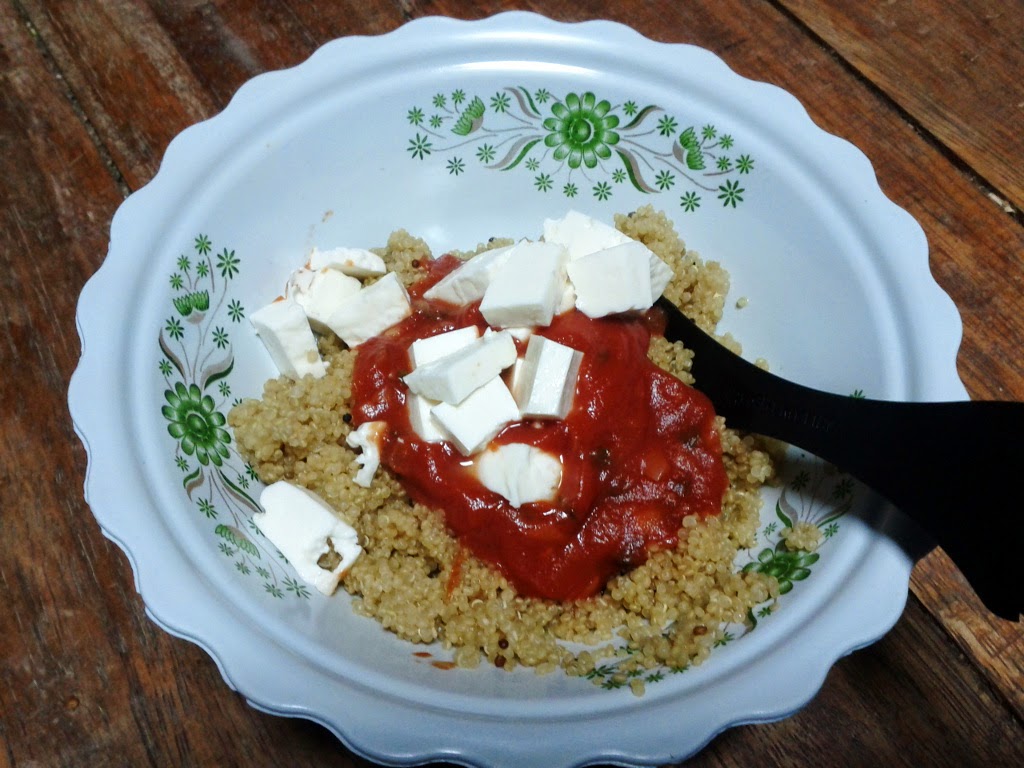
Monday, 9 March 2015

Giardia and the Elusive Toilet Soap

Giardia is a small bacteria or parasite or whatever, that can contaminate humans and animals through water, food and direct contact to infected people/animals. It is especially prevalent in countries with not much hygiene or clean water. The water in Peru and Bolivia seems clean enough - but still we have always either purified the water with pills or boiled it. But with the food, we haven't been so careful, and we have ofcourse shaken many people's hands and patted dogs and cats (or that was just me - Andrés knows better ;-). Moreover, soap is never found in public toilets or in most hostels, and so on. And I wonder how much it is used after going to the toilet... But I guess people here would have stronger immune systems than someone from a country of hysteric hygeinic rules that forces shops to throw good food away and is the only place in the world where eggs are refrigerated from it pops out of the hen's butt till it hits the frying pan.
So for a few weeks now I have been sick in the stomach, on and off, with alternating constipation and diarrhea. And the last few days also fatigue, where it's been a whole mountaineering exercise for me climbing some stairs or walking up a small hill. It's not certain I have Giardiasis, but next week I'll probably buy the medicine against it anyway.

Because I know the symptoms from previous experience! When I was in Cambodia about 8 years ago I got Giardiasis over several periods, even though I was on medication several times. I guess patting the dogs, playing with the kids and giving them swimming lessons in the mud pond didn't help much to avoid it. And the side effects have been with me since, as a constant souvenir from my time there. Ever since my time in Cambodia I've been struggling with irritable bowel syndrome. My mum made me go to the doctor and ask if I still could have Giardia. I could hardly make myself ask the doctor because I thought they would think it was stupid, especially if I said I had read about Giardia persisting for years, on the internet - because it seems like doctors don't like it when you talk about things from the internet. But so many websites and online forums mention cases with people getting irritable bowel syndrome after having Giardiasis. And so many people write about their doctors waving their persisting symptoms off with stress, bad lifestyle and so on, without taking tests. But even the tests seem to be quite precarious in proving Giardia as it only sometimes shows positive, even though the victim has it in him or her. I'm sorry for saying this but sometimes doctors don't seem to give a shit about taking the time to study about or think about the causes their patients might have to their symptoms, and just tell them some common cause like stress.
Here's a link to a study from Bergen University that concluded the existence of chronic conditions such as irritable bowel syndrome or chronic fatigue, years after patients had Giardiasis:
http://cid.oxfordjournals.org/content/early/2014/08/12/cid.ciu629.abstract

Saturday, 7 March 2015

Finally Bolivia!

After one month in Peru, we finally entered Bolivia, with some days of relax in Copacabana.We will upload a couple of posts from here.


Foreigners not welcome!

Our last days in Peru have been very hectic. We were in four different towns/villages in one day and slept in dirty hostels, but Andrés got some valuable data. Thanks to the help of Kelluyo Tambo's manager, Alonso, we managed to get in contact with otherwise suspicious local people. And they have all the right to be so. In may 2011, a Canadian mining company got the rights to exploit the silver mine of Santa Ana in Huacullani, which lead to massive protests all around the Puno region, mainly because of environmental reasons and small benefits to the local communities. This event is commonly known as the 'aymarazo'. And still today this area is very suspicious of white people. Luckily, and thanks to Alonso's help, we did not encounter any problems, and the locals were very helpful, as they learnt about my thesis project and wanted to help in order to get a better commercial option for their qañawa, which is one of their main incomes.
Qañawa field affected by a dry spell early in the season. The plants are small and the yield will also be.

Huacullani, the place where the 'aymarazo' protests started. Further up to the left, out of the picture, the mining activity  is plundering the mountain of this valuable resource.


Friday, 6 March 2015

Kanccora Yacango

For a week we went higher up in the mountains where qañawa is grown. And lived in a Tambo in Kanccora Yancango, with no running water, but this time with a kitchen. A Tambo is an official governmental building for the development of rural areas. They serve as a link between the Peruvian government and the rural farming communities. In these high areas, many locals tend to be quite suspicious of strangers, because they have experienced exploitation of their resources by foreigners without real benefits to the locals. This made it difficult for me, Andrés, to gather some data, but I figured out that most of the qañawa crops there were mainly for self-consumption. And since my thesis is about value chains, the information I could collect here was not very relevant to my thesis project.


A QAÑAWA field at last!! They are similar in characteristics to quinoa, but a much smaller plant.
It has different names: in Peru it's called Cañihua and in Bolivia Cañahua. The Aymara call it Qañawa.

Another Qañawa field, but red. Next to the Qañawa field is a potato field which has been affected by the frost - the tops of the plants are black and dried out, giving a very low harvest for this year. But the Qañawa are much more resilient and have not been affected by the frost. 

On our second day in the mountains we hiked up to some cliffs to see a cave with old drawings on the walls. 

We didn't have a bag to carry food and water for our hike, so Andrés used our 'Awayu' blanket like the Aymara carry things.

Thanks to the help of the old community leader, we found the cave paintings. This woman was in amazingly good shape and could walk up the mountain faster than all of us.


The manager of the Tambo, Miguel, and Andrés talked to and learned from the local farmer communities about agricultural practices.

In front of our Tambo, was a vast plain where herders had their sheep, alpacas and pigs, and where we went to fetch water from a well.

To one of the meetings Andrés held for the authorities of the district, one of the men came by horse, like in an old western movie. It is the first and last horse we have seen in Peru. Donkeys, bikes, motorbikes or walking are much more common means of transportation.

In the top right our Tambo with red roof can be seen.

Friday, 27 February 2015

Quinoa, papas & pancakes

The food we eat in Peru...

Breakfast, Danish style. Plus coca powder and tropical fruits.

Quinoa soup.

Again quinoa soup, but this was the best in the world. Mixed with milk and cheese.

Quinoa again...

Huge Peruvian portions. With trout and chuños, a kind of dried potatoes that can keep for years.

Trout again.

Carachi soup. A native fish of  Lake Titicaca.

More fish.

The most delicious fried cheese! with purple potatoes, which are kind of sweet.

Horse bean, chuño and potato buffet.

'Mate de muña', very good for the stomach.

No need to comment.

First time making pancakes.

The last time we made pancakes. The portions are growing for each time... 65!

Cake can also be found in Peru, but nowhere near the Danish cakes ;)


Thursday, 26 February 2015

An unexpected trip to a mountain village

Last Friday we were invited by a nice family we met in church the Saturday before, to eat breakfast with them at the market where they sell chicken. Or so we thought. So we got up at 6am, ate a small breakfast and walked the 5km to town. There we met the father of the family, and after a few pictures together with his friends, we went to his house. There they asked us if we wanted to go visit their relatives in a village in the mountains for lunch. So apparantly we had misunderstood the breakfast at the market part, and this was turning out to be a full day excursion. But it turned out to be an awesome experience in a tranquil mountain village. We were met by their very friendly relatives in a cute house, lying in a valley. The mother was weaving a beautiful coloured rug. And after they gave us some delicious homebaked bread and mango, we went for a hike up a hill. Up to 4270m. The view from the top reached all the way to Ilave, the town we had come from. And the fact that there were wild pumas and vicuñas (a type of llama) in the area, made the trip more adventurous, although we didn't see any. On our way down, the guys (including Andrés) helped herd some sheep from another hill side. When we came back to the cottage, we had a humungous lunch, with fried trout, tons of potatos, large green beans, maize and vegetables. And second dish we got fish soup with a carachi fish lying in each bowl. Carachi is a native fish of Lake Titicaca. The food was delicious. And yes, Andrés ate the trout and the fish soup! All of it. 
After a relaxing afternoon, we drove back to the town. It got a bit late because they stopped at a friend's house to talk. We tried to find a taxi or bus back to our house, but there were none. So we had to half run, half walk back, with very dark clouds all the way around us, all with flashes of lightning and very loud thunder claps in them. We were walking in very open country and felt pretty exposed. But we prayed for God's protection, which we always can trust in, but sometimes is hard to do. He protected us the whole way, and instead of a frightening storm, we were walking through a spectacular light show. And we reached home in time before the rain started pouring down.


Our friend Jaël from Ilave tries on his mother-in-law's homemade poncho.


On our hike up the hill, where Bhone was practicing with his homemade slingshot, used for the sheep.


While the guys were out herding sheep, Shandy and Maria tried a conversation with very bad Spanish (by Maria) and a few English words (by Shandy). But she was cool to try and understand Maria's attempt at Spanish.

Monday, 23 February 2015

Carnival in the fields

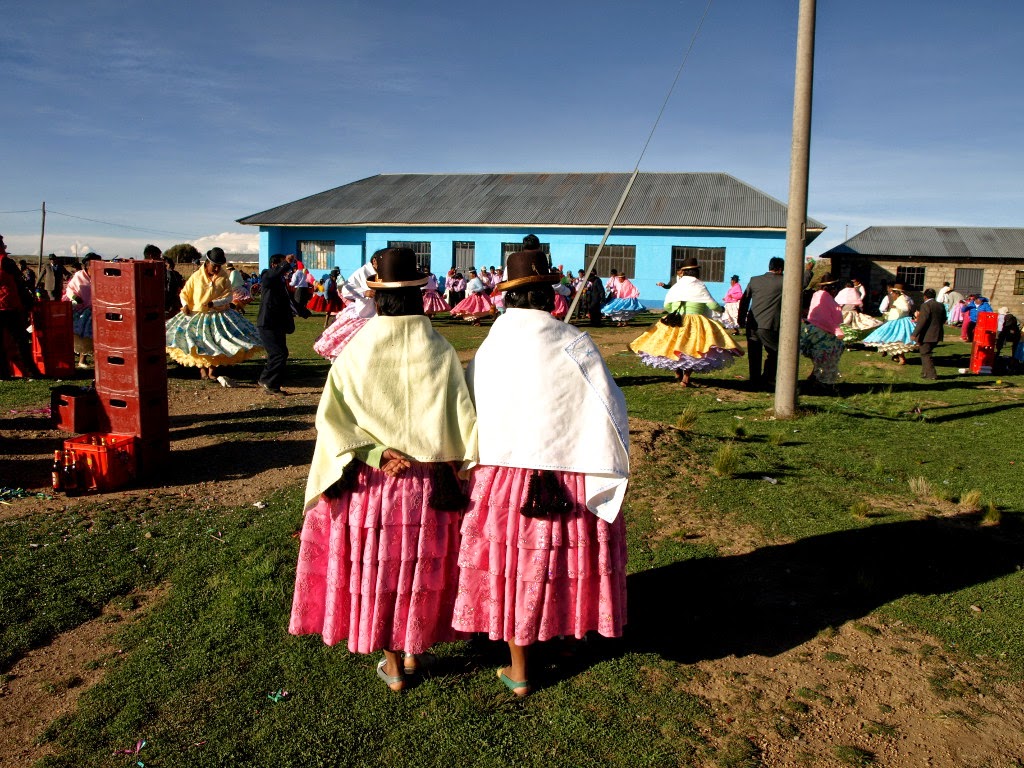
Last Thursday we were invited by a guy who works for the government at our village, to a carnival close to his village. At the moment all the villages around here have carnivals with dancing, drinking and music. At this village, we started first at one community building where they danced, then they walked along a road through the fields to meet another dancing group from another village. It went on till dark and it all culminated in the dancers throwing things into the audience - things like 3liter soda bottles, watermelons, huge tuna cans, all hurtling towards our heads in the dark! And most of the dancers were drunk. It was crazy! I protected myself behind Andrés and he stood ready to catch anything flying towards him. He only caught something by his leg though, something that came flying down low and hit him. No harm done. But people do get hurt we heard. 
The children were also running around with cans of snow spray and filling people's faces with it. See the last picture, where the grown-ups are also going crazy with snow spray.