Showing posts with label La Paz. Show all posts

Sunday, 17 May 2015

Details from La Paz

After living in La Paz for almost two and half months, we are leaving tomorrow. And even though we have been here for a while, we have realised that we haven't got that many pictures of the city of La Paz. But we couldn't leave the city without making a post about this impressive place.
La Paz has a beautiful city center with old Spanish style houses and churches from the colonial time, it is also the most touristic area, where you can buy lots af colourful clothes and other things. They also have colourful buses which are very characteristic of this city.


The traffic of La Paz is awful. It seems that there are no rules and that pedestrians are never right. Therefore you have to be extremely careful when you walk around, because even if you have the right to cross a street, a car can turn a corner at top speed and you will never be right.
Consequently, the government is trying to make the cars at least respect the zebra-crossings, using very enthusiastic zebras. We hope it works.


We couldn't talk about La Paz without talking again about the Teleférico. It is a very good way to get through the steep sides of the valley where La Paz is placed in. Only 3 lines are working now, but 6 more lines are coming, which will help very much the already overcrowded streets of the city.


The government supports the culture very much, so there are often cultural activities in the streets, mostly for free. It is understandable in a country with such a rich cultural heritage they have. There are also many museums, which yesterday were all open for free, so we enjoyed visiting the very interesting Etnographic Museum. 


When you walk in the streets of La Paz, you can often get surprised if you look up and see how high the city reaches in all directions. There is more than 1000 meters difference from the highest point to the lowest, so it makes the city the most impressive we have seen so far.


Apparently, La Paz is the city in the world with most demonstrations. It has in average almost one every day of the year!
Even if the social situation in Bolivia has improved remarkably in the latest years, there are still big differences between rich and poor and a lot of corruption, so demonstrations are understandable. At least now they have the right to do it, and are not killed for it, like with the previous president Gonzalo Sánchez de Lozada, who killed 64 persons and injured 228 in demonstrations against his exporting plans for the Bolivian gas. Short after that he got assylum in the U.S.A. where he is giving classes at the University about Latin America and Bolivia, even though he is prosecuted for Crimes Against Humanity. Once again, the U.S.A. and their disgusting politics.


Another detail from La Paz are the thousands of cables connecting every corner of the city, without any plan or order. Sometimes small epifitic plants (bromeliads) grow on them, giving a very tropical feel.


Finally, we couldn't finish this post without mentioning again mount Illimani, which has deep significance in the City and is more than once represented in wall paintings and other graphic representations. It is definitely a beautiful mountain.

Notice Illimani depicted in the street art.

Wednesday, 6 May 2015

Gorges, gullies and hoodoos

Around 10 days ago we tried to find something called 'Valle de las Ánimas' (Valley of the souls) in the SE of La Paz, and after asking several people we arrived to this place. We are still not sure we found the right area, but we can say we discovered a beautiful and interesting landscape, full of gorges, gullies and hoodoos. There were quite a few very narrow gorges, which we decided to venture in to. One of them was more than 100 meters long with 10-30 meters vertical walls (maybe higher) and with a width between 0.5-2 meters. Really impressive! 


Thursday, 30 April 2015

Restaurant Gustu

A few weeks ago Andrés was invited to dine at Restaurant Gustu along with some Amaranth farmers who were in consideration of selling their crops to the restaurant. Gustu is a restaurant in Zona Sur, the wealthier part of La Paz, and was started by an organisation called Melting Pot Bolivia which was created by Claus Meyer. If you're Danish you'll know who Claus Meyer is - the professional chef and co-founder of Noma, which has been voted best restaurant in the world in 2010, 2011, 2012 and 2014. Melting Pot Bolivia is an initiative he started, to train locals to be chefs, using the rich variety of ingredients that are produced in Bolivia, with a main focus on native foods. One of those is amaranth, which was the reason Andrés came along with a group of farmers to Gustu, and ate there for free! He also has interviewed Melting Pot Bolivia in relation to his thesis, as cañahua is one of the ingredients they use in their haute cuisine, mainly for bread making.
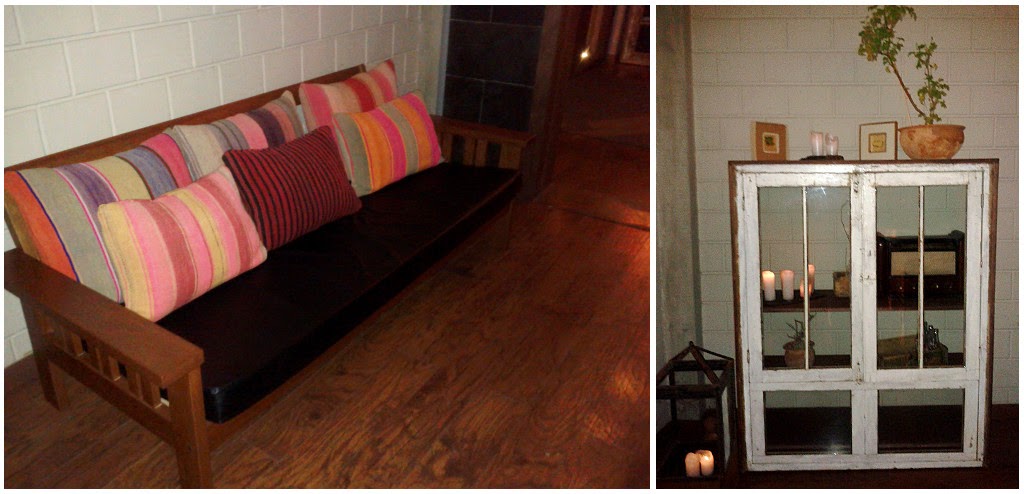
Even though it is an expensive restaurant, its philosophy behind it is really interesting. They support only small Bolivian producers, not only in the food ingredients, but also in the decoration, furniture, etc. in the restaurant. Many of their products are organic as well, and they educate underprivileged locals as chefs. The service is the best we have ever experienced in a restaurant, they even served gluten-free food for Maria, but of course you pay for it.
After knowing all this, we had to go there together, as a once-in-a-lifetime experience. And we enjoyed it!


The paintings behind the staircase and behind the colourful lamp are actually paintings of Dronning Margrethe (the Danish queen). When she visited Gustu for her birthday, it was arranged for many Bolivian painters to paint her in different versions, many of which she is depicted as a Cholita (Aymara woman) and so on. I think there are perhaps 20 paintings of her standing on the wall. It looked pretty cool.
The pillows have typical colours/patterns used for blankets here. And they're probably alpaca or llama wool.

As you can see, there is a picture of a Cholita for the women's toilet, and fresh little towels for each time you dry your hands.

I'll try to explain what I remember of the dishes. From the top right: 1. alternative menu with pictures of the main ingredients used in each dish. 2. A small appetizer with glazed onions and herbs on top of dehydrated cabbage leaf. 3. gluten-free cañawa buns with homemade quinoa butter, coca butter and regular butter. 4. Caramelised boiled carrots. 5. Trout, probably from Lake Titicaca. 6. Different types of native potatoes with a potato sauce. 7. Amaranth cream with juicy tiny tomatoes and dehydrated crunchy leaves of celery. 8. Racacha root with some kind of a delicious sauce under it, apple sauce next to it and cinnamon on the side (to represent the earth that the root came from). 9. A dessert of goat cheese ice cream with lettuce and sugar crumble on top. There was also one more dessert, a nice pineapple icecream, but we forgot to take a picture of it. All this (with more details) was explained to us by the waiters each time they came in with a new dish - sometimes it was the apprentice chef her-/himself that came out and explained the dish to us. 

The kitchen with an open view for the guests to see what was going on inside. The picture is taken from our table.

Monday, 20 April 2015

Bolivian Street Art

It was a nice surprise to see so much beautiful street art in Bolivia. Most of their motives are cultural, showing Inca symbols or Aymara people, for example 'cholitas' (Aymara women with traditional clothing), etc. Very interesting. You don't need to go to a museum to see art in Bolivia!


Sunday, 19 April 2015

A dog life

Dogs are such an important part of La Paz and Altiplano life, that we couldn't avoid making a blog post about them.
You can find dogs everywhere, in all sizes and even in all races. Expensive dogs like Shar Peis, Huskies, etc. run in the streets without owners. But after a while, we have realised that many of these "street-dogs" actually have owners. They just let them run wherever they like.
Dogs here are also extremely good to cross streets full of fast driving cars. And people are so used to dogs, that you can find dogs sleeping everywhere, some times in places where they can easily be stepped on but somehow they don't. Dogs are well treated here. At least much better than what we have seen in Asia.
Some dogs can be violent and bite random people, like Andrés. Now he has to get 10 injections against rabies and a 5 day treatment with antibiotics. Luckily the government pays all the vaccinations. 
Sometimes we meet dog-gangs as well, especially in El Alto. Once I saw 10 dogs walking together owning the street, they were heading to their "puddle pub" for some drinking and fighting (see the last photo).

Some rasta dogs like to grow dreadlocks and are proud of it.

Dead dogs are lying everywhere, or at least they look like they're dead...probably after a hard night of drinking and fighting.

Dog gangs roam El Alto.

Tuesday, 31 March 2015

Valle de la Luna

Last week we met with some friends from Denmark here in La Paz, Sandy and Lasse who live at the moment not far from Santa Cruz, here in Bolivia, and Sabine who came for a visit. As they were going to visit the badland landscape of Valle de la Luna (Moon Valley), we decided to join them. We took an alternative route to what is recommended and took the cable way, which is an attraction in itself and then a taxi. The badlands are located near the village of Mallasa and it was definitely interesting to see, although it was much smaller than we expected. Different types of cactus, succulents and desert type shrubs grew on the eroded soil. We just managed to see all what was to see, before the rain came. After that we went back to La Paz and ate nice vegetarian food at Magick restaurant in Sopocachi, just one minute from where we live. It was nice to spend our day in good company.

On our way with the Teleférico to the Southern part of La Paz.


In the background the peak La Muela del Diablo (Devil's Tooth) can be seen, which we want to visit before we leave.


At Magick in good company!

Sunday, 22 March 2015

La casa del Montículo

Our house in La Paz. It lies next to a park with a pretty awesome view. The park is called Montículo and is a kissing park, where many couples go and kiss, or many school kids go and write romantic things on the walls. We often go and eat our lunch there under the huge eucalyptus and cypress trees, while we're trying not to feed the dogs that wander by, and while we kiss each other once in a while so we can blend in with the crowd. The view from the park looks over the eastern and southern part of La Paz, with Illimani a 6438m high mountain looming in the background. It's an incredible mountain, but doesn't show itself very often in the rainy season. The picture of it at the end of this blogpost is a rare sight...at least for the 2 weeks we've been in La Paz. 
We came to La Paz by bus two Sundays ago, and found a cheap hostal in the middle of the tourist area. Right across from the hostal was the best vegetarian restaurant ever, with really good food and a cosy atmosphere. To find a more permanent place to live we bought a newspaper and looked through the apartment rentals. We found 6, of which 2 we went to look at the next day. The one we settled for was perfect for us: really cheap, not too fancy but still cozy, hot shower and kitchen!, next to a park, very close to the office Andrés is collaborating with on his thesis, and friendly neighbours, in a big house divided into several apartments where mainly foreigners live. However, we had to wait before we could move into the apartment because the guy that lived there before had not moved all his stuff, and apparantly in Bolivia you can't just throw people's things out on the street if they are too lazy to move it themselves. But luckily he took it two days later and we were able to move in. 
We really felt God has been helping us so much. We felt that it wasn't just luck that we found this place, where we could focus on studying, but still hang out with neighbours that not only speak Spanish. It's also close to a Spanish language school, where I'll begin courses in April. There's a market close by, it's close to a Teleférico (cableway) station, it's only 20min walk from the centre with all the restaurants and tourist shops, but still in an area where you can hear the birds and walk one minute to a park with huge trees. We felt like God's trying to show us that we really can trust him to take care of us and that we don't have to worry about the future (which we were doing while we were waiting to get the apartment). Because we're his children and he's a father that has no limitations and an endless love toward us. So why wouldn't he take care of us? Any good father takes care the best they can of their children. The dads in my family: my oldest brother, my dad, my cousins (and my other brother soon to become a father too) are all really awesome (or will very soon, in June, be awesome) dads to their children, they do so many things for them! And I couldn't imagine a God who created the world, who's above everything else and who is love and goodness himself, shouldn't take care of us and give us joy in our lives, and give us good things if we ask for it, or even when we don't ask for it sometimes. That's what he's promised us. I especially like two places in the bible that talks about us and God: "For the Lord your God is living among you. He is a mighty saviour. He will take delight in you with gladness. With his love, he will calm all your fears. He will rejoice over you with joyful songs." and the other one: "to know the love of Christ which passes all knowledge; that you may be filled with all the fullness of God. Now to Him who is able to do exceedingly abundantly above all that we ask or think, according to the power that works in us, to Him be glory...by Christ Jesus to all generations, forever and ever."  I especially like the parts about how we make God happy, just because we're his children I guess; that he will calm all our fears even the small ones; and that what we ask of him he will help us with, even in much better ways than we had thought of. 

Our kitchen. The stairs lead up to a half-floor with a large matress on the floor. To the right of the staircase is a small toilet and shower with hot water!

Dinner with our neighbours. A basque with his kid and a French-Venezuelan couple. They made ratatouille for us :)

The view from the Montículo park.

The Teleférico with a very eroded landscape in the background.


The Montículo park, seen from the Teleférico. 
Illimani, when it is visible.